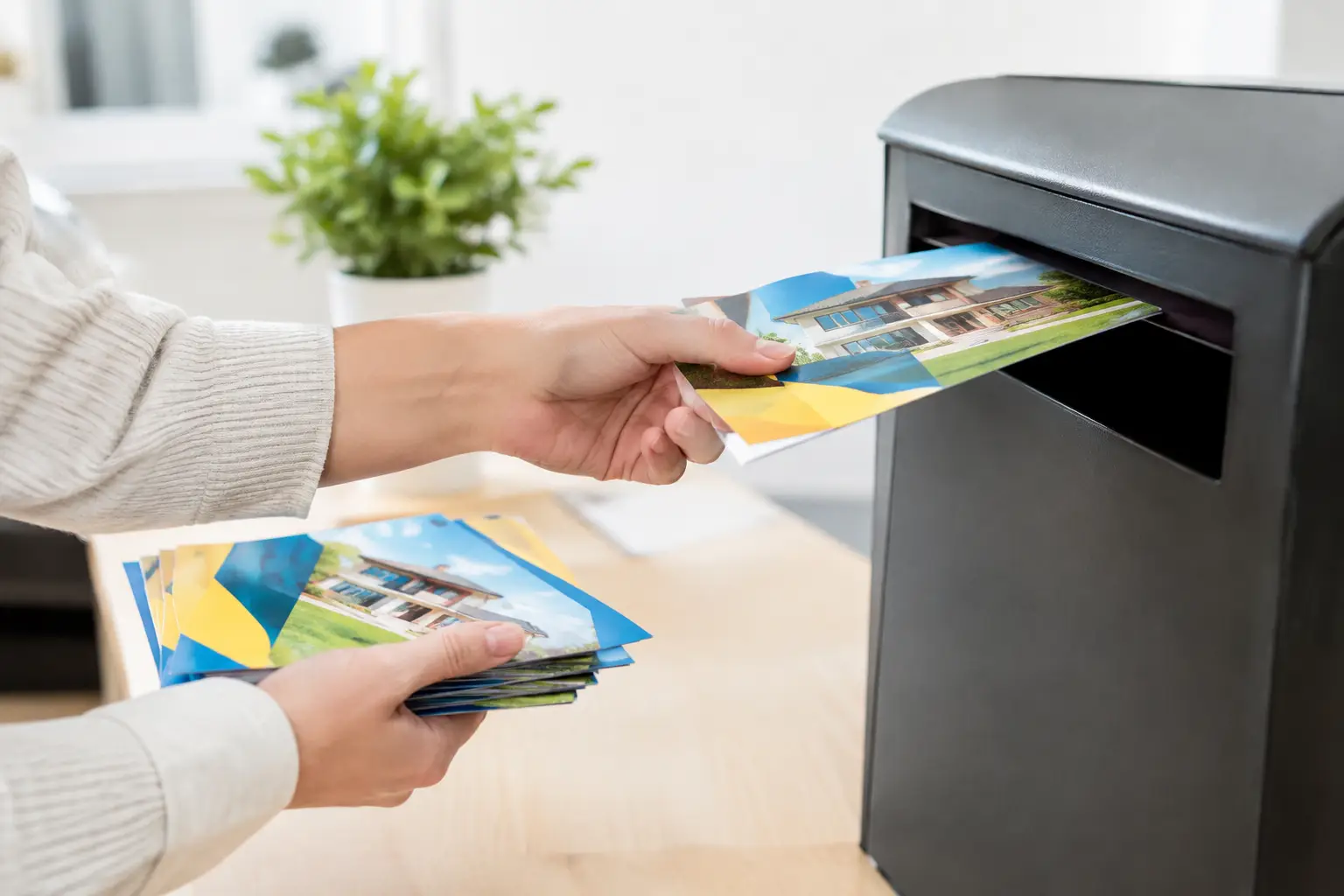
A new restaurant opens near the Antelope Valley Mall. A roofing company has openings after a storm. A real estate agent needs local homeowners to know about an upcoming open house. In each case, the question is the same: can businesses mail flyers to the homes most likely to respond? Yes. A well-planned flyer mailing can put a clear offer, event, or service directly in front of local customers without relying on a crowded social feed or a search ad click.
The strongest results come from treating the flyer as part of a complete direct-mail campaign, not simply a printed sheet sent to every address available. The format, mailing route or list, postal preparation, offer, and print quality all affect what the recipient sees and whether the campaign earns a response.
Can Businesses Mail Flyers Through USPS?
Businesses can mail flyers through the U.S. Postal Service as long as the piece meets the applicable mailing requirements. A flyer may mail as a letter, flat, postcard-style mailpiece, or oversized piece depending on its final size, thickness, weight, and preparation. That classification matters because it affects postage, processing, and the design choices available to your business.
For many local promotions, a postcard or folded self-mailer is more practical than a loose sheet. It provides a defined space for the recipient address, return address, postage area, and required postal markings while protecting the message during delivery. A flyer can also be inserted into an envelope when the campaign calls for a more formal presentation, additional information, or a coupon that should feel more personal.
The best format depends on the job. A restaurant grand opening may need a colorful postcard with a limited-time offer. A medical office or financial service may prefer an envelope package that feels more private and professional. A club event could benefit from a bright, larger-format piece that is easy to spot in the mail.
Choose the Right Flyer Before You Print
A mailed flyer has two jobs: it must get through the mail properly, and it must communicate quickly when it reaches the customer. Mailing specifications should be considered before design and printing begin, not after thousands of pieces are already produced.
Size is one of the first decisions. Smaller mailpieces can be economical and easy to handle, while larger pieces give you more room for photography, service details, menus, maps, and coupons. Larger is not automatically better. If the message is a single offer with one clear call to action, a compact postcard may be more efficient. If you are promoting several services, seasonal packages, or a detailed event schedule, a larger format may give the information room to breathe.
Paper stock also changes how your business is perceived. A thin, low-cost sheet may work for a short-term announcement, but it can feel disposable. A heavier cardstock postcard gives offers, real estate listings, retail promotions, and service introductions a more established appearance. Glossy stock can make color photography stand out, while uncoated stock may be a better fit for pieces that need writing space, such as appointment reminders or response forms.
Your flyer should make the main reason to act obvious within seconds. Lead with the offer, the service, or the event. Support it with a strong image or a clean visual hierarchy, then give customers a simple next step: call, visit, scan, bring in the coupon, or schedule an appointment. Avoid filling every open area with text. A direct-mail piece does not need to explain everything. It needs to start the conversation.
Mailing Lists and Routes Determine Who Sees It
Printing a professional flyer is only half the project. The mailing plan determines whether that flyer reaches a useful audience.
Some businesses choose a targeted mailing list. Lists can be selected using geographic areas and, where appropriate, customer characteristics relevant to the campaign. A home improvement company may focus on neighborhoods with owner-occupied homes. A retail business may target households within a practical driving distance. A business-to-business campaign may use a list of companies by industry, size, or location.
Other campaigns work well with Every Door Direct Mail, often called EDDM. This approach lets businesses mail to every residential or business address on selected carrier routes without using individual names and addresses on each piece. It can be an effective choice for local restaurants, salons, fitness centers, event venues, political outreach, community organizations, and new businesses introducing themselves to nearby neighborhoods.
There is a trade-off. Route-based mailing reaches broad local coverage and can simplify list selection, but it may include households outside your ideal customer profile. A targeted list can be more selective, though the data, addressing, and preparation may require more planning. The right option depends on your service area, budget, offer, and how specifically you need to reach potential customers.
A practical starting point is to define the area where customers are most likely to visit, request service, or make a purchase. For a Lancaster or Palmdale service business, that might be several nearby ZIP Codes, a set of neighborhoods, or carrier routes surrounding a storefront. From there, campaign volume and postal options can be matched to the goal.
Plan for Postage and Mail Preparation
Postage is not a single flat number for every flyer. Pricing can vary based on the piece’s dimensions, weight, shape, quantity, presort level, destination, and mailing method. This is why estimating postage after design is risky. A small change in size or stock can move a piece into a different category and affect the campaign budget.
Mail preparation also matters. Depending on the mailing method, pieces may need addresses printed in a designated area, postal barcodes, facing identification, sorting, trays, bundles, or other documentation. Bulk-mail campaigns generally require careful processing before they are accepted for distribution.
Businesses do not need to manage those details alone. Working with one provider for printing, mailing-list support, addressing, and postal handling reduces the chances of a costly production mistake. It also eliminates the back-and-forth that happens when a printer, data vendor, and mail house are all working separately.
At JR’S Handling, the goal is to make that process more manageable for businesses that want professional printed materials and dependable local outreach. With more than 34 years of direct-mail postcard marketing experience, the team can help coordinate the production and mailing steps so business owners can stay focused on customers and daily operations.
Build an Offer Worth Mailing
People do not respond to paper because it arrived in their mailbox. They respond because the message is useful, timely, or hard to ignore. Before mailing flyers, make sure the offer gives recipients a reason to keep the piece instead of tossing it aside.
A clear offer can be a percentage discount, a dollar-off coupon, a free estimate, a seasonal special, a grand-opening incentive, an event invitation, or a limited-time package. It should include a deadline when appropriate, but only if that deadline is real. Artificial urgency can weaken trust, especially for local businesses that depend on repeat customers and referrals.
Use a trackable response method whenever possible. A unique offer code, a dedicated phone number, a landing-page address, or a coupon customers bring into the store can help show which campaign produced results. Ask new customers how they heard about you as well. Even simple tracking gives you useful information for the next mailing.
Frequency can be just as valuable as one large drop. A landscaping company may mail in early spring, mid-summer, and fall. A retailer may coordinate flyers with holiday weekends or new inventory. Repetition helps local customers remember your name when they finally need the service. The message can change, but the visual identity, contact information, and service promise should remain consistent.
Common Flyer Mailing Mistakes to Avoid
The most expensive direct-mail mistake is mailing a piece that does not clearly say what the business wants the recipient to do. If the offer is buried, the phone number is difficult to find, or the design tries to promote too many unrelated services, response can suffer.
It also pays to avoid these common problems:
- Choosing a size or paper stock before confirming mailing requirements and postage.
- Mailing to a broad area without considering where customers can realistically buy or receive service.
- Using low-resolution images, crowded copy, or colors that do not print clearly.
- Forgetting to include a strong call to action, contact details, and an offer deadline when relevant.
- Running a campaign once without tracking inquiries, coupons, calls, or sales.
A proof review is a valuable final step. Check names, phone numbers, addresses, offer terms, spelling, image quality, and postal placement before production begins. A small correction at the proof stage is simple. The same correction after a mailing enters the postal system is not.
Make Your Next Mailing Easier
Flyers remain a practical way to introduce a business, promote an offer, fill an event, and stay visible in the neighborhoods you serve. They work best when the print piece is designed for the mail, the audience is chosen with purpose, and the campaign has a clear path from mailbox to customer action.
If you are considering a flyer mailing, begin with the customer you want to reach and the one action you want them to take. From there, the right format, quantity, mailing method, and budget become much easier to plan. Give us a try today and put a professional direct-mail campaign to work for your business.