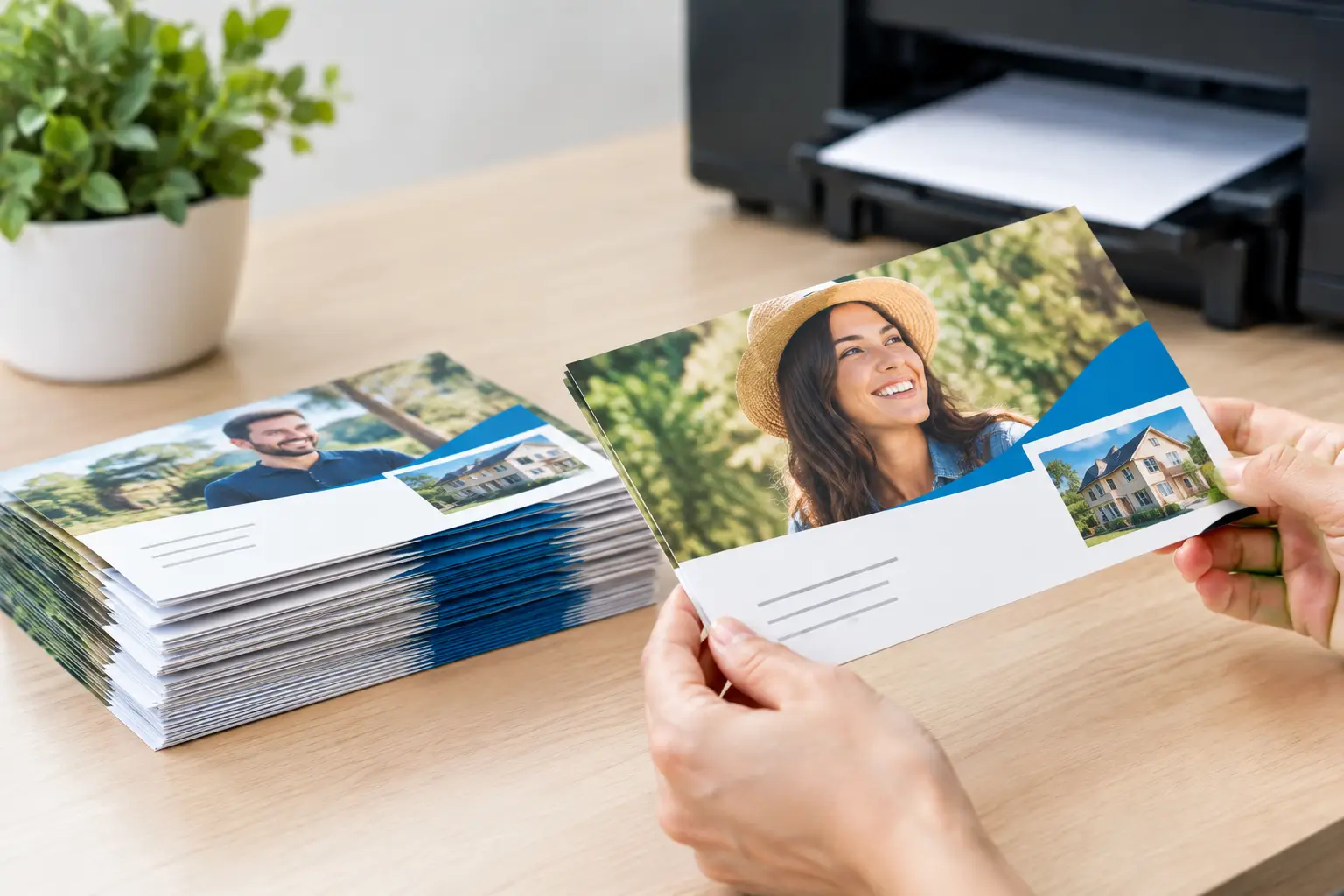
A homeowner does not respond to the same message as a first-time customer. A family near a retail location may care about a weekend offer, while a former customer may need a reason to come back. Variable printing gives businesses a practical way to make each direct-mail piece more relevant without running a separate print job for every audience.
For Lancaster, Palmdale, and Southern California businesses competing for local attention, relevance can make the difference between a postcard that gets noticed and one that gets discarded. Variable data lets a campaign speak more directly to the people receiving it while keeping production and mailing organized under one plan.
What Variable Printing Means for Your Campaign
Variable printing, often called variable data printing, is a digital printing process that changes selected information from one printed piece to the next. The overall design can remain consistent, but names, addresses, offers, images, service details, coupon codes, or calls to action can change based on the mailing list.
For example, a real estate professional can send one postcard design to homeowners in several neighborhoods while changing the neighborhood name, recent sales information, and agent message for each area. A restaurant can mail a return-visit offer to past guests and a first-time discount to nearby households that have not visited before. A plumbing company can promote drain cleaning to one audience and water-heater service to another, using the same campaign framework.
The goal is not personalization for its own sake. The goal is a mail piece that feels more useful to the recipient and gives the business a clearer reason to expect a response.
Why Personalized Direct Mail Gets More Attention
People sort mail quickly. A generic promotion may still work when the offer is strong and the audience is well chosen, but a message that references the recipient, their area, or a relevant need has a better chance of earning a second look.
Personalization can be as simple as including a recipient’s name in a letter or as targeted as changing the offer by customer history, ZIP Code, household type, or distance from a business location. The right approach depends on the quality of the available data and the purpose of the campaign.
A local retailer may not need complex customer information to benefit. Segmenting a mailing list by neighborhood can allow the retailer to promote the closest store location, a local event, or a ZIP Code-specific offer. A service business with a customer database can go further by sending seasonal reminders based on prior work, such as maintenance notices, inspection offers, or replacement recommendations.
This approach also supports better tracking. Unique coupon codes, QR codes, phone numbers, or landing-page references can be printed for different list segments. That makes it easier to see which offer, neighborhood, or audience produced calls, visits, and sales.
Common Uses for Variable Printing
Variable data works well across more than postcards. Postcards are often the starting point because they are visible, cost-effective, and easy for recipients to scan, but businesses can use the same capability in letters, envelopes, flyers, invoices, and promotional inserts.
A few applications are especially useful for local marketing:
- Customer retention mailers can include a customer’s name, past service category, loyalty offer, or renewal date.
- New mover campaigns can welcome households that recently entered a service area with an introductory offer.
- Neighborhood campaigns can feature area-specific language, nearby locations, or services suited to a particular community.
- Event promotions can print individualized invitations, RSVP codes, or event details based on audience type.
- Sales follow-up letters can pair a professional letter with a personalized offer and a direct next step.
The printed piece still needs a clear design, readable type, and a strong offer. Variable information does not fix a weak message. It makes a well-planned message more relevant.
Start With the Mailing List, Not the Design
The most successful variable campaigns are built around a clear audience. Before choosing colors, postcard size, or paper stock, decide who should receive the piece and why that group is likely to care.
A business may use its own customer list, a prospect list, or a combination of both. Existing customer lists are useful for retention, referrals, upgrades, and reactivation. Prospect lists can be selected using factors such as geography, household characteristics, business type, or other available criteria. The best list is not always the largest one. A smaller, well-defined audience can be more cost-effective than sending a broad message to people with little reason to respond.
Accuracy matters as well. Duplicate records, outdated addresses, incomplete fields, and inconsistent formatting can create waste or make personalization look careless. If a record does not contain a reliable first name, for instance, it may be better to use a general greeting than risk printing incorrect information.
A dependable print-and-mail provider can help organize mailing data, prepare it for production, and coordinate postal requirements. That saves internal staff from having to manage separate vendors for list support, printing, addressing, and bulk-mail handling.
Build a Message That Changes With Purpose
Not every element needs to vary. In fact, changing too much can make a campaign harder to manage and dilute the brand. Keep the core design consistent, then identify the details that can make the message more timely or specific.
For a home-services business, the variable fields might include the recipient’s name, city, nearest office, and an offer tied to the season. For a club promoting an event, fields may include member status, event location, ticket deadline, and a personalized registration code. For an auto business, the message might change based on the type of vehicle or the customer’s last service date.
The offer should remain easy to understand. If recipients have to read several paragraphs to figure out what they receive and how to claim it, personalization will not carry the campaign. A strong mailer usually answers three questions quickly: What is being offered? Why should I act now? What should I do next?
Balance Relevance With Privacy and Cost
Variable printing gives businesses more options, but more data is not automatically better. Use information that customers reasonably expect a business to have and that serves a clear marketing purpose. Referencing overly specific details can feel intrusive, especially when the connection between the data and the offer is unclear.
Cost is another consideration. Digital variable printing is particularly effective for targeted campaigns, multiple versions, and shorter-to-medium runs. For a very large campaign with one identical design and no changing information, a traditional print approach may be the more economical choice. The right production method depends on quantity, format, personalization needs, timing, and postal strategy.
There is also a planning trade-off. Personalized campaigns require careful data review and proofing before production. That work is worthwhile when the campaign is targeted, but it should be allowed for in the schedule. Checking sample records and every variable field before approval helps prevent costly mistakes.
A Better Workflow for Print and Mail
When printing and direct-mail logistics are handled as separate projects, details can get lost between vendors. A postcard may look great but arrive without the correct addressing setup. A list may be ready, but the mail format may not meet postal requirements. Coordinating the work through one experienced provider reduces those handoffs.
At JR’S Handling, variable campaigns can be planned alongside the practical details that determine whether a direct-mail effort runs smoothly: print format, list preparation, addressing, bulk-mail processing, and distribution. That end-to-end coordination is especially valuable for businesses that need to move quickly without assigning an employee to chase production updates.
Before launching, review a final proof that shows real sample data, confirm the mailing quantity and audience segments, and establish how responses will be tracked. Keep the campaign focused on one offer and one primary action, whether that is calling for an estimate, bringing in a coupon, visiting a location, or registering for an event.
Variable printing is most effective when it helps a local business treat recipients less like a mailing count and more like potential customers with different needs. Give us a try today when you are ready to turn a targeted list and a clear offer into direct mail that works harder for your business.