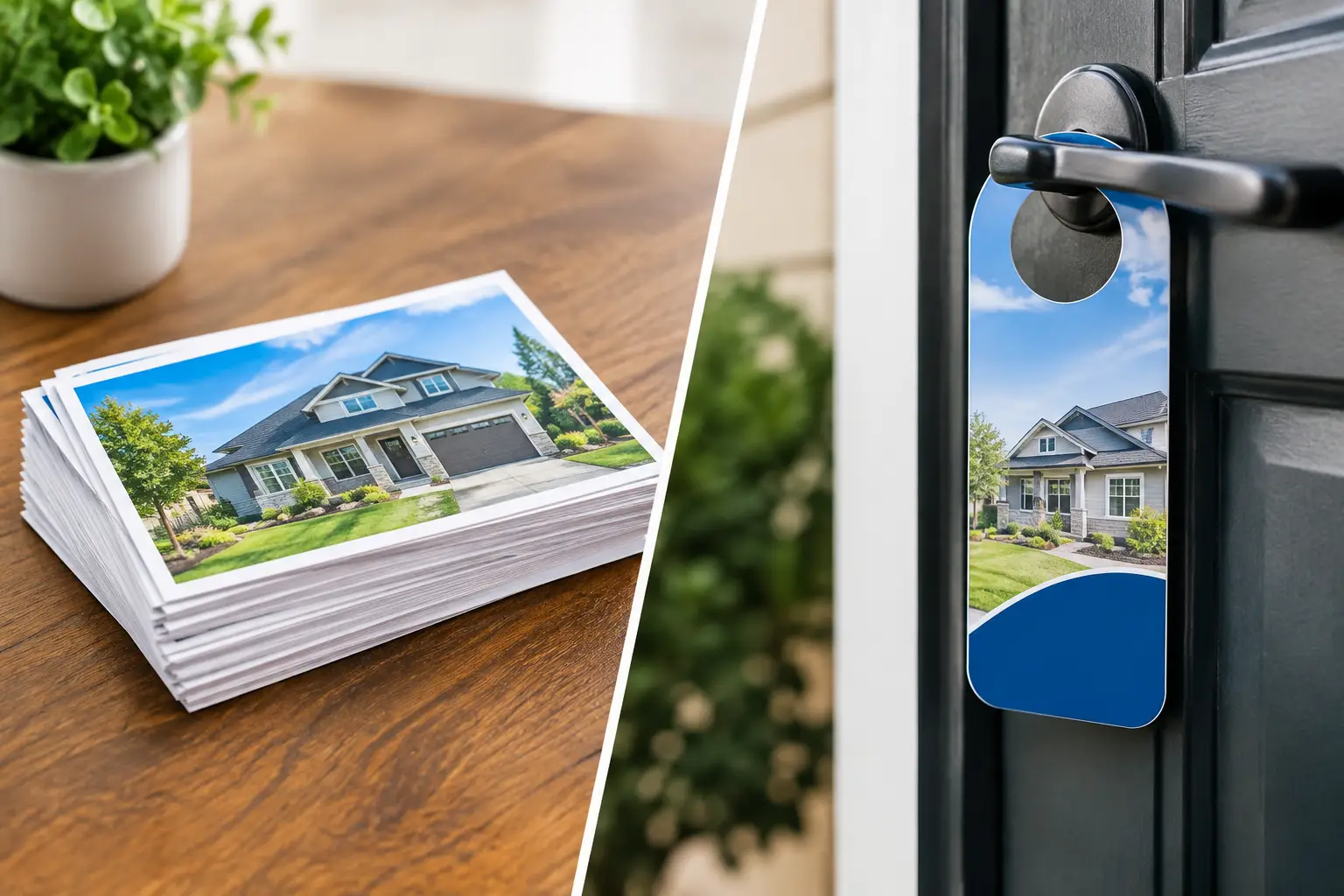
A roofing company has a crew working in one neighborhood. A restaurant needs to fill seats for a weekend special. A real estate agent wants to introduce a new listing to nearby homeowners. In each case, postcards versus door hangers can be a smart comparison, but the better choice depends on how precisely you need to reach people, how quickly your offer needs to land, and what action you want them to take.
Both formats put a physical message in front of local customers. Both can carry a strong offer, a phone number, a QR code, and the professional visual presentation that helps a business get noticed. Their delivery methods, targeting options, and best uses are different. Choosing the right one can help you control campaign costs while creating more qualified local leads.
Postcards Versus Door Hangers: The Practical Difference
A postcard enters the home through the mail. It can be sent to a carefully selected mailing list, to every address on a carrier route, or to existing customers. It is a practical choice when your audience is defined by location, home value, business type, customer history, or other mailing-list criteria.
A door hanger is delivered directly to a residence or business door. It is immediately visible before the recipient brings in the mail, which makes it especially useful for neighborhood-based promotions and time-sensitive offers. It does not require an address label or postage, but it does require dependable, permitted distribution in the areas you want to cover.
The strongest choice is not always the format with the lowest unit price. It is the format that gets a clear offer to the people most likely to respond, at the right time, with enough reach to make the campaign worthwhile.
When Postcards Make More Sense
Postcards work well when targeting matters as much as coverage. A home-service company may want to mail only to single-family homes within certain ZIP codes. A senior living community may need to reach households within a defined age range. A retailer may want to send a special offer to prior customers or residents who have recently moved into the area.
Because postcards travel through the mail, they offer useful flexibility for recurring campaigns. A business can mail a monthly promotion, announce seasonal services, send appointment reminders, or follow up with customers after a purchase. Consistency helps keep a company familiar when the customer is ready to act.
Postcards also provide more room for a polished marketing message than many people expect. A well-designed piece can lead with one strong headline and offer, then support it with service details, testimonials, a map, or a short list of reasons to choose your business. The key is not to crowd every inch. Make the next step obvious: call, scan, visit, or bring in the card.
For companies that need help managing addresses, postage requirements, presorting, and postal delivery, an end-to-end direct-mail process removes a major operational burden. The business can focus on the offer and the customer experience while the print and mailing work is handled in one coordinated campaign.
Best uses for postcard campaigns
Postcards are often the better fit for grand openings, service reminders, real estate farming, retail promotions, event invitations, customer reactivation, and new-mover outreach. They are also effective when a business needs to reach beyond a few nearby blocks without relying on a field distribution team.
A postcard campaign requires lead time for printing, addressing, postal preparation, and mail delivery. If your promotion must be in people’s hands within days, plan early or consider whether door hangers can better support the timing.
When Door Hangers Make More Sense
Door hangers are built for close-range visibility. A homeowner sees the message at the front door, often before seeing anything else from that day. This gives local service businesses a useful advantage when they are already active in an area.
For example, a landscaper completing work on one street can promote a neighborhood package nearby. A pest-control company can distribute a seasonal inspection offer before peak activity. A cleaning service can introduce a first-time customer special in neighborhoods within its travel area. The message feels local because it is local.
Door hangers are especially effective when the offer has a short response window. A restaurant can promote a weekday special. An event promoter can build awareness in the days before a local event. A home-service company can offer a limited number of openings for the coming week. Their physical placement creates a direct, immediate impression.
The trade-off is targeting depth. Door hangers can target a geographic area with precision, but they generally cannot isolate households by customer history, age, income, or other list-based details. Distribution also must be organized carefully. Local rules, private-property policies, gated communities, and “no soliciting” restrictions can affect where and how materials may be placed.
Design matters at the door
A door hanger needs to communicate quickly. The person picking it up should understand the service, offer, and call to action in seconds. Use a bold headline, easy-to-read contact information, and a design that stays clear from a few feet away.
The hanger shape itself is useful because it is less likely to be mistaken for ordinary mail or a loose flyer. Still, the format is not a substitute for a compelling offer. “Call for a free estimate,” “Save on your first service,” or “Ask about neighborhood pricing” gives the recipient a reason to respond now.
Compare Reach, Cost, and Control
Postcards and door hangers can both produce strong results, but they give you control in different places. Postcards offer greater audience selection and mailing scale. Door hangers offer immediate neighborhood presence and can avoid postage costs.
| Campaign factor | Postcards | Door hangers | |—|—|—| | Delivery method | Postal delivery to addresses | Hand delivery to doors | | Targeting | Mailing lists, routes, customer data | Specific streets, neighborhoods, and nearby areas | | Timing | Requires postal production and delivery time | Can be distributed quickly when planned properly | | Best strength | Reach and audience selection | Local visibility and immediate offers | | Main cost factors | Printing, mailing preparation, postage | Printing, distribution labor, and route planning |
A lower per-piece cost does not automatically mean a lower campaign cost. A door hanger campaign may reduce postage, but labor and distribution oversight need to be factored in. A postcard mailing has postage costs, but it can reach a larger or more refined audience without requiring a team to walk each route.
Response measurement should also guide the decision. Use a unique offer code, phone number extension, landing-page address, or QR code for each campaign. When you know which message and distribution area generated calls, you can improve the next drop instead of guessing.
Match the Format to the Customer Journey
Think about when people are likely to need your service. If customers plan ahead, compare options, or make decisions over several weeks, postcards can provide the repeat exposure that builds familiarity. This suits professional services, real estate marketing, planned home improvements, and recurring retail offers.
If customers can act quickly because the need is visible or timely, door hangers can be a better match. A homeowner may notice a yard-care offer while looking at an overgrown lawn. A nearby restaurant promotion can influence dinner plans that same day. A contractor working in the neighborhood can turn visible activity into additional estimates.
Many businesses do not need to choose only one format. A coordinated campaign may mail postcards to a broader service area, then use door hangers in selected neighborhoods where crews are working or where response potential is highest. The postcard establishes recognition; the door hanger adds urgency and local relevance.
Build an Offer Worth Keeping
Whether you choose postcards, door hangers, or both, the message should make business sense for the recipient and for your margins. Avoid vague claims such as “best service” without giving people a reason to respond. A clear introductory discount, a free consultation, a package price, an event date, or a limited-time bonus gives the piece a purpose.
Use professional print quality because recipients make fast judgments. Crisp images, accurate color, clean trimming, and readable type reinforce that your business is organized and reliable. Include your business name, phone number, service area, and a single primary call to action. Too many competing messages can reduce response.
JR’S Handling can coordinate commercial printing and direct-mail execution for businesses that need postcards produced, addressed, and mailed without managing separate vendors. For door hanger campaigns, dependable printing helps ensure your materials are ready for distribution with a consistent, professional appearance.
Before committing to a large run, define the neighborhood, the offer, the campaign date, and how success will be measured. Give us a try today, then let the response from real local customers guide the next campaign decision.