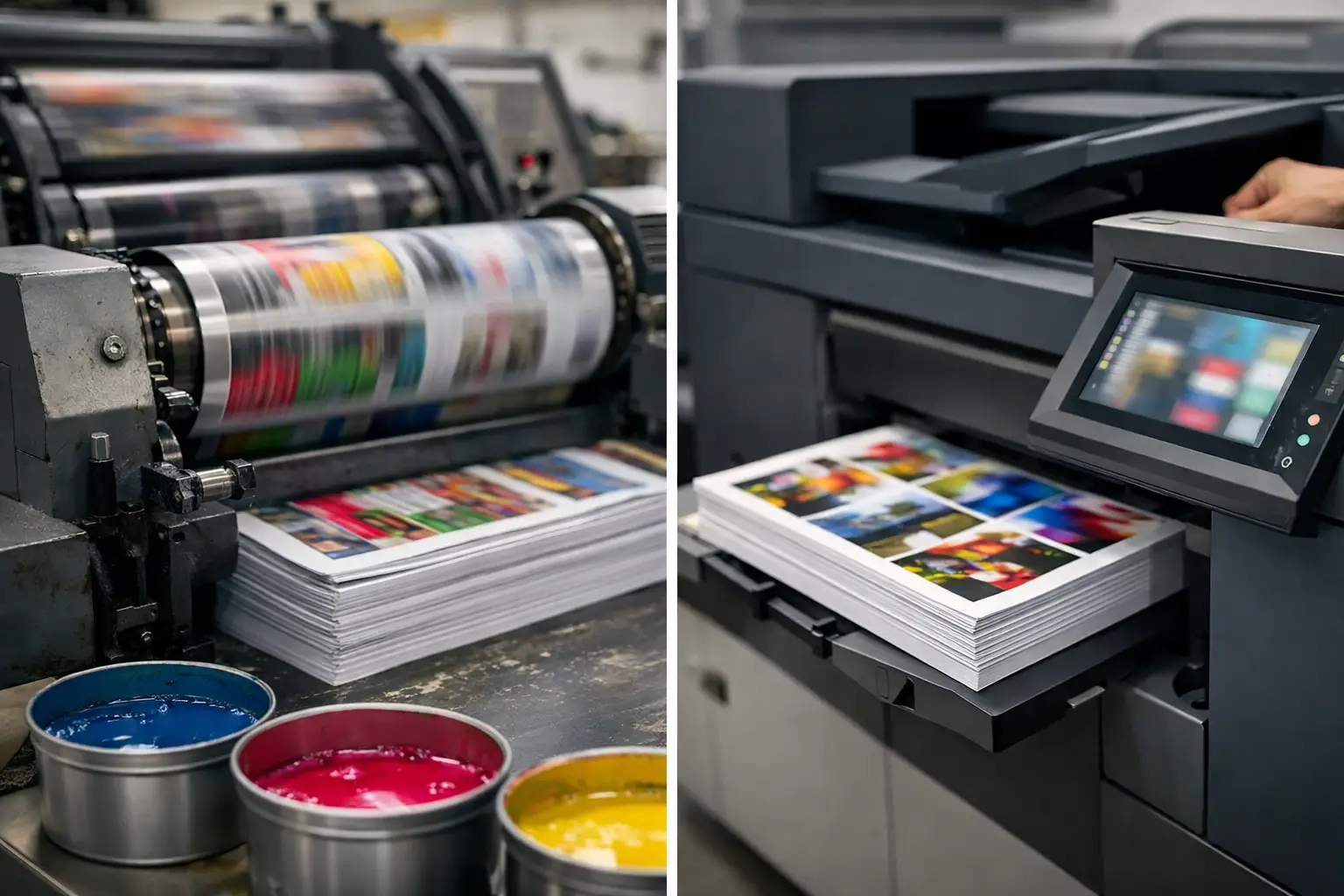
A 5,000-piece postcard campaign and a last-minute batch of 75 presentation folders should not be produced the same way. When comparing offset versus digital printing, the right choice comes down to the quantity you need, the timeline you are working with, the materials involved, and what you want each piece to accomplish for your business.
Both methods can produce professional marketing materials. The difference is in how the job is set up and where each process delivers the best value. For Lancaster, Palmdale, and Southern California businesses that rely on postcards, brochures, fliers, business cards, invoices, and direct mail, understanding that difference can prevent wasted budget and production delays.
Offset Versus Digital Printing: The Basic Difference
Offset printing transfers ink from metal plates onto a rubber blanket and then onto paper or another print surface. It requires more setup before the first finished piece comes off the press, but that setup becomes cost-effective when the quantity is high. Offset is a long-established commercial printing method known for consistent color and clean results on larger runs.
Digital printing sends the artwork directly from a digital file to the production press. There are no printing plates to create, so jobs can move from approved artwork to production much faster. This makes digital printing a practical choice for shorter quantities, versions with different names or offers, and projects that need a quick turnaround.
Neither process is automatically better. A business printing 100 event fliers has different priorities than a real-estate team sending 20,000 postcards to selected neighborhoods. The smartest choice is the one that supports the campaign instead of forcing the campaign to fit the press.
When Offset Printing Makes Sense
Offset printing is often the better value for large-volume projects. Although setup costs are higher at the beginning, the per-piece cost generally drops as the quantity increases. If you are ordering thousands of postcards, brochures, door hangers, club fliers, or inserts for a bulk-mail campaign, offset may provide the most efficient cost structure.
It is also a strong option when color consistency is especially important. Businesses with established brand colors, detailed photography, or large areas of solid color may prefer offset production for a highly controlled result. Offset presses can use Pantone spot colors in addition to standard process colors, which can be useful when an exact branded shade is required across many printed pieces.
Paper selection is another reason to consider offset. Larger offset jobs can be produced on a broad range of paper stocks, finishes, and specialty materials. That flexibility matters when a brochure needs a particular feel, a high-end sales piece needs a heavy coated stock, or a printed item requires a format that is not ideal for a digital press.
Offset is usually best when the artwork is final and the quantity is substantial. Once plates are made and the press is running, changing an address, price, phone number, or promotion is not a simple adjustment. For a stable design that will be distributed widely, that is rarely a problem. For a campaign that needs frequent changes, it can become expensive.
Common offset projects
Offset production is often well suited to large postcard mailings, multipage brochures, high-quantity business forms, letterhead, envelopes, catalogs, and promotional pieces ordered in volume. It can also be a smart choice for businesses that use the same materials repeatedly and want to order enough inventory to reduce unit cost.
The trade-off is time. Plate preparation and press setup mean offset work generally needs more lead time than a short digital job. Planning ahead gives you the opportunity to take advantage of its efficiencies.
When Digital Printing Is the Better Choice
Digital printing is built for speed, flexibility, and smaller quantities. A local service business may need 250 appointment cards, a retailer may need 100 promotional signs for a weekend sale, or an office may need updated envelopes after changing its address. Digital production allows those jobs to be printed without the setup process required by offset.
It is also the practical option when each printed piece needs to be different. Variable-data printing can personalize a direct-mail piece with a recipient’s name, address, neighborhood-specific message, unique offer, or tracking code. Rather than printing one generic postcard and hoping it speaks to everyone, a business can tailor the message while keeping the production process manageable.
That flexibility is especially useful in direct mail. A roofing company might mail one offer to homeowners in an older neighborhood and another to a newer development. A real-estate professional can feature recent nearby sales. An event promoter can produce different versions for separate audiences. Digital printing makes those targeted versions possible without treating each version as a completely separate print job.
Digital is also a good fit for testing. Before committing to a large campaign, you can print a smaller batch with two different headlines, offers, or designs. The response can help guide the larger order. Testing does not eliminate risk, but it gives businesses more information before they spend on a major mailing.
Common digital projects
Digital printing works well for short-run postcards, updated business cards, small batches of brochures, event fliers, invoices, presentation materials, personalized mailers, and materials that need to be produced quickly. It can also reduce the cost of keeping documents current because there is no need to store thousands of outdated pieces in anticipation of future use.
The unit cost of a digital piece may be higher than offset at large quantities. For a short run, however, the lack of plate and setup costs often makes digital the more economical option. Quantity is not the only factor, but it is an important one.
Quality Is About More Than the Printing Method
Businesses sometimes assume offset automatically means better quality. Offset remains an excellent choice for demanding color work and high-volume projects, but modern digital presses produce sharp, professional materials that meet the needs of many business applications. A well-designed digital postcard can look polished, persuasive, and completely appropriate for a customer-facing campaign.
The quality of the final piece also depends on the artwork, paper stock, finish, trimming, mailing requirements, and proofing process. A low-resolution logo will not look better simply because it is printed on an offset press. A strong file, correct dimensions, readable copy, and enough contrast between text and background make a noticeable difference regardless of method.
For direct mail, practical details matter as much as appearance. The mailing panel must have proper space, addresses need to be accurate, and the finished size and thickness must work with postal requirements. Choosing a printer that understands both production and mailing helps avoid a situation where a beautiful postcard needs to be redesigned because it cannot be mailed as planned.
Choosing the Right Method for Your Campaign
Start with the job itself. Consider how many pieces you need, when they must be ready, whether the information may change, and whether you need personalized versions. Then consider how the pieces will be used. A handout at a local event, a recurring invoice form, and a neighborhood postcard campaign all call for different production decisions.
If you need a large quantity of identical pieces and have time to plan, ask about offset pricing. If you need a limited run, quick production, or personalized messaging, ask about digital. If your project sits somewhere in the middle, compare both options. The best value is not always the lowest initial quote. It is the method that produces the right quantity, protects your brand presentation, and helps the campaign reach customers when it matters.
For a direct-mail project, production should be coordinated with the list, addressing, postal preparation, and delivery schedule. Printing 10,000 postcards is only one part of the job. The audience selection and mailing execution determine whether those postcards arrive in the right homes and support the response you want.
JR’S Handling helps businesses coordinate commercial printing and direct-mail production in one working relationship, so the print method can be matched to the campaign instead of handled as an afterthought. Whether you need a short-run promotional piece or a large local mailing, a clear quote and a conversation about your goals can save time, control costs, and keep the job moving.
Bring your quantity, deadline, artwork, and distribution plan to the conversation. With those details in place, you can choose a printing method that gives your next piece a professional start and puts it in front of the people most likely to respond.