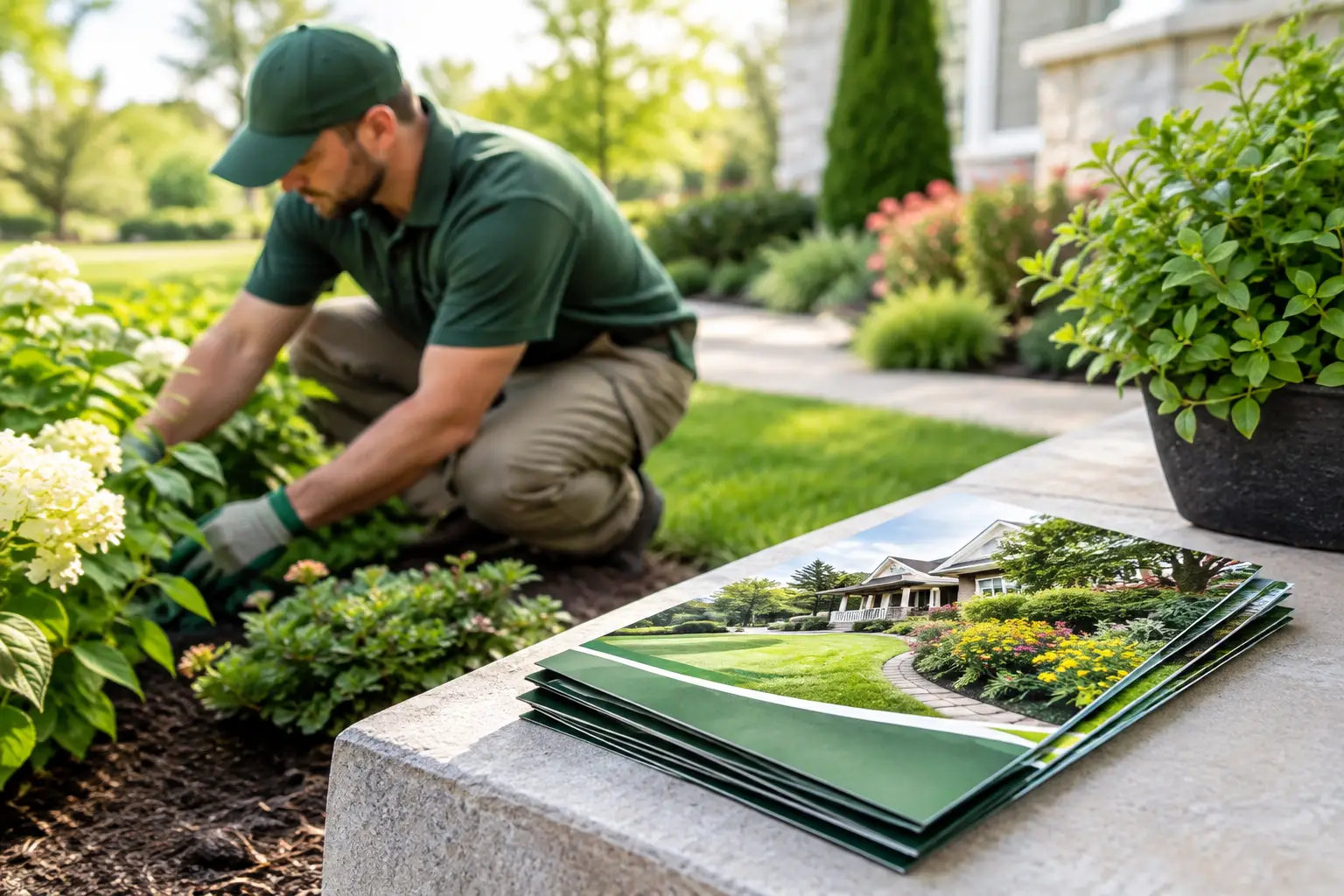
A homeowner may not need a landscaper when they see your postcard on Tuesday. But when their sprinkler breaks on Saturday, their lawn turns brown in July, or they finally decide to rebuild the backyard, the company they remember gets the call. Strong landscaper print campaign results come from putting a professional, clear offer in front of the right local households often enough to be remembered when the need becomes urgent.
For landscaping companies, print is especially effective because the service is local, visible, and tied to a customer’s property. A well-designed postcard, door hanger, yard sign, or vehicle decal gives prospects a tangible reminder that you serve their neighborhood. The goal is not simply to distribute more pieces. It is to create a campaign that produces calls, estimate requests, booked jobs, and repeatable revenue.
Start With the Result You Want
Before choosing paper stock, postcard size, or a mailing route, decide what success means for the campaign. A company promoting weekly maintenance will measure results differently than one selling irrigation repair, artificial turf installation, landscape design, or seasonal cleanup.
A maintenance campaign may focus on recurring-service inquiries. A higher-ticket hardscape campaign may generate fewer responses, but each qualified estimate can be worth far more. Neither result is automatically better. The right measurement depends on the service, average job value, crew capacity, and how quickly you can follow up.
Set a clear campaign objective such as booking spring cleanups in a defined neighborhood, filling open maintenance routes, generating estimates for new landscape installations, or keeping your name in front of past customers before the busy season. Once the objective is clear, the offer and distribution method become much easier to choose.
What Improves Landscaper Print Campaign Results?
The best campaigns match a specific service with a specific local audience. A generic message saying that you provide quality landscaping may build awareness, but it gives a homeowner little reason to act now. A focused message creates a stronger response: “Free irrigation inspection for homes in your neighborhood,” “Schedule your spring cleanup by March 15,” or “Upgrade your front yard with drought-tolerant landscaping.”
Your offer should be practical and easy to understand. It does not always need to be a large discount. Priority scheduling, a free estimate, a seasonal package, or an added service can be effective when it fits your margins. The key is to give the recipient one clear next step: call, text, scan a QR code, or request an estimate.
Professional presentation matters just as much. Landscaping is a visual business. Use strong photos of completed projects, healthy lawns, clean hardscapes, colorful plantings, or organized crews at work. Include your business name, phone number, service area, license information when applicable, and a short description of what makes your company dependable. Avoid filling every inch with text. Homeowners should understand the main offer in a few seconds.
Use the Right Printed Format
Different printed products do different jobs. Postcards work well for reaching a selected group of homes through direct mail. They are visible immediately, do not require an envelope to be opened, and give you room for photos, service details, and a call to action.
Door hangers are useful when you want a neighborhood presence around an active job site or a concentrated service route. They can be especially effective after completing a visible project nearby, provided distribution follows local rules and community restrictions. A message such as “We just completed a landscape upgrade in your area” helps turn nearby activity into additional estimates.
Yard signs build local proof. With a customer’s permission, placing a clean, readable sign at an installation, cleanup, or hardscape project lets nearby homeowners see who performed the work. Vehicle decals and magnets extend that visibility wherever your crews travel. Business cards, brochures, and estimate folders support the sales conversation after a lead comes in.
Using several formats can reinforce your message, but only when they are coordinated. A postcard promoting irrigation repair should not send callers to a brochure focused solely on tree trimming. Keep the offer, visual style, and contact information consistent across every piece.
Target Neighborhoods Instead of Mailing Everywhere
A broad mailing can make sense for brand awareness, but it is often not the most efficient choice for a growing landscaping company. Targeted direct mail allows you to focus spending on households that are more likely to need and afford the service you are promoting.
Consider the practical details of your best customers. Are they homeowners rather than renters? Do they live in established neighborhoods with mature landscaping? Are they near your current service routes, allowing crews to work more efficiently? Are they in areas where yards, irrigation systems, patios, or outdoor living spaces match the jobs you want more of?
For example, a company looking to build recurring maintenance accounts may mail neighborhoods close to existing weekly routes. This can reduce drive time and make each new customer more profitable. A company promoting landscape renovation may choose areas with larger lots and older homes where upgrades are more likely.
Mailing lists and postal distribution require planning, but they should not become another administrative burden for your office. An experienced print-and-mail provider can help organize production, address the pieces, prepare bulk mail, and coordinate distribution so your team can stay focused on estimates and customer service.
Timing Makes a Major Difference
Landscaping demand follows the calendar. A campaign that arrives after homeowners have already hired someone may still build awareness, but it will usually miss the strongest response window. Plan around the services you offer and the weather patterns in your area.
Spring is a natural time for cleanups, maintenance programs, irrigation checks, planting, and landscape improvements. Early summer can support lawn care, water-conscious upgrades, and outdoor living projects. Fall is a strong period for cleanups, pruning, overseeding where appropriate, and preparing properties for the next season. Winter can be useful for planning and booking larger design-build work before the spring rush.
One mailing is rarely enough to establish recognition. A homeowner may hold onto a postcard, see your truck a week later, then call after receiving a second piece. Repetition builds familiarity. That said, frequency should match your budget and service capacity. There is no advantage in generating more calls than your team can answer or more estimates than you can schedule promptly.
Track Calls, Quotes, and Booked Work
Print campaigns should be measured beyond the number of pieces mailed. Response rate is helpful, but booked revenue tells the more meaningful story. Build simple tracking into every campaign so you know what generated the lead.
Use a campaign-specific offer code, a dedicated phone number, a unique landing-page address, or a question your office team asks every new caller: “How did you hear about us?” Train everyone who answers the phone to record the answer consistently. If a prospect says they received a postcard, note the mail date, neighborhood, and offer when possible.
Then follow the path from response to revenue. Track how many inquiries became estimates, how many estimates became jobs, the average job value, and whether the customer became a recurring account. A campaign with 20 calls and two profitable installation projects may outperform one with 60 calls for low-margin work.
Keep in mind that print often creates delayed and assisted conversions. Someone may see your postcard, search for your company later, and call the number on your website. That does not mean the postcard failed. Ask new customers how they first became aware of your company, and look for patterns over several campaign cycles.
Make Follow-Up Part of the Campaign
A prompt response can determine whether a lead becomes a customer. If your postcard invites homeowners to request a free estimate, make sure calls are answered, voicemail is returned quickly, and estimate appointments are available. Strong printing cannot make up for slow follow-up.
After completing an estimate, leave behind a polished brochure, business card, or service menu. If the homeowner is not ready, a follow-up postcard can keep the conversation active without relying on repeated phone calls. For past customers, seasonal postcards are a practical way to encourage the next service and maintain professional visibility.
JR’S Handling helps businesses bring print production, mailing-list support, bulk-mail preparation, and postal distribution together in one coordinated process. That can save landscaping companies time while keeping the campaign focused on the neighborhoods and services that matter most.
The most valuable print campaign is not the one with the biggest mailing count. It is the one that reaches the right homes, presents your work professionally, gives people a reason to respond, and helps your crews stay busy with profitable local jobs. Give us a try today when you are ready to turn neighborhood visibility into measurable growth.